The history of enterprise planning is central to TM1 Fanboy’s research into organizational decision-making. Starting with TM1, it follows the development of Decision Support Systems, spreadsheets, OLAP, enterprise planning, business intelligence, data culture, artificial intelligence, and decision intelligence. The aim is to understand how technology has changed the way organizations plan—and why questions of trust, ownership, adoption, and judgment continue across different generations of systems.
For finance leaders, this history provides context for current decisions about planning platforms, data foundations, forecasting, transformation, and AI. It shows why faster calculation does not automatically produce a better forecast, why standardization has to accommodate local knowledge, and why technical implementation and organizational use are different measures of success.
The Question Behind the Research
How has technology changed organizational decision-making—and what has remained unchanged?
TM1 provides an unusually long view of this question because it has remained relevant across several eras of enterprise computing. Its history connects changes in technology with the continuing work of budgeting, forecasting, scenario planning, performance management, and managerial decision-making.
Evidence and Method
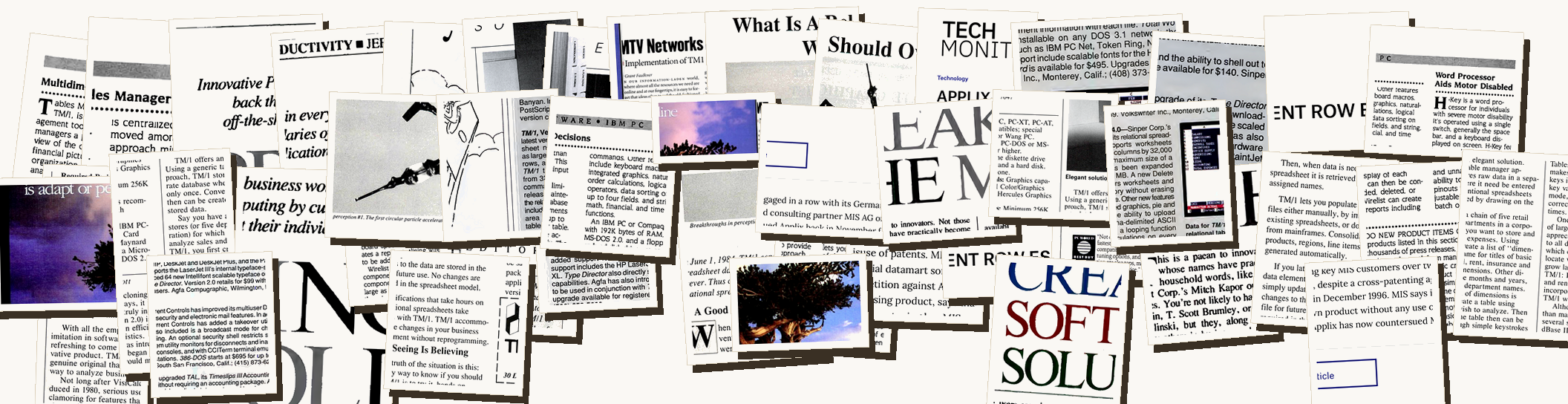
The research is based on dated material:
- manuals, documentation, screenshots, and version records;
- advertisements, brochures, and vendor announcements;
- trade-press notices, reviews, and market comparisons;
- conference slides and user-group material;
- archived websites, patents, filings, and acquisition records; and
- interviews, oral histories, and firsthand recollections.
Current Reconstruction
The public chronology focuses on six major transitions:
- 1983 — Founding: Sinper was formed and TM/1 began its commercial history.
- Around 1990 — Global spread: international distribution and practitioner networks began carrying TM1 into markets across Europe, Asia, and Australia.
- 1996 — Applix acquisition: Applix acquired Sinper and brought TM1 into a larger software company.
- 2003 — Applix rebuilt around TM1: after selling its CRM business, Applix refocused on business intelligence and business performance management, making TM1 central to the company’s next phase.
- 2007–2009 — From Cognos to IBM: Cognos acquired Applix, IBM acquired Cognos, and TM1 emerged from the transition as IBM Cognos TM1.
- 2015–2016 — Planning Analytics: IBM rebranded Cognos TM1 on Cloud as IBM Planning Analytics in 2015; Planning Analytics Local 2.0 followed in December 2016, with the TM1 engine remaining central.
The working chronology is longer and continues to develop as additional evidence is verified.
Corrections and Contributions
Dated documents, manuals, screenshots, conference material, corrections, contradictory evidence, and firsthand recollections are welcome. Useful contributions explain what the material is, who created it, when it was created, and whether any restrictions apply. Submissions are assessed as historical sources and placed in context before they influence the public record.